
NEWS & EVENTS
소식
이벤트
2026 서울대학교 의료 인공지능 융합인재 양성 사업단 세미나 시리즈
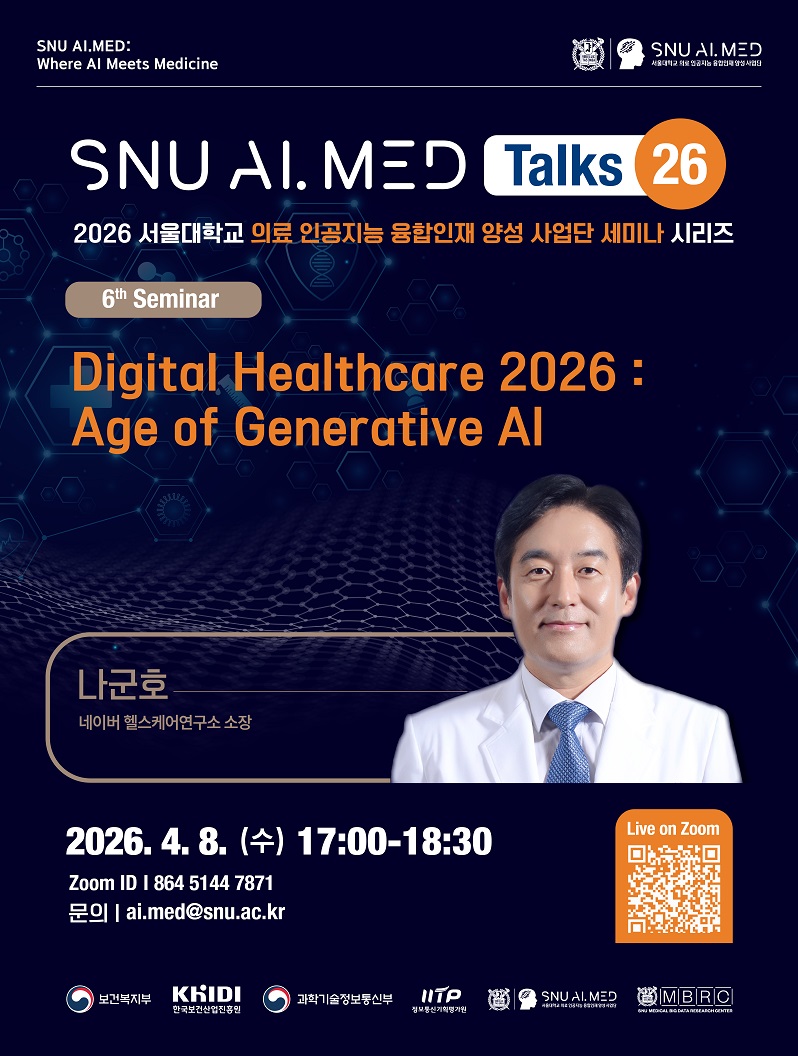
2026 서울대학교 의료 인공지능 융합인재 양성 사업단 세미나 시리즈 ‘SNU AI.MED Talks 26’의 여섯번째 세미나에 여러분을 초대합니다.
이번 세미나에서는 네이버헬스케어연구소 나군호 소장의 ‘Digital Healthcare 2026 : Age of Generative AI’룰 주제로 진행됩니다.
- 일시 : 2026. 4. 8.(수) 17:00-18:30
- 장소 : 온라인(via Zoom)
- ID : 864 5144 7871 (하단 포스터 QR 코드 접속 가능)
- https://snu-ac-kr.zoom.us/j/86451447871

With the emergence of Open AI's Chat GPT in 2022 and Google's Bard in 2023, interest in digital healthcare is increasing not only in various sectors of society but also in the medical field. The past of digital healthcare begins with the Electronic Health Record (EHR) of the 1980s. It was adopted in storage and prescription and developed until the early 2000s with the digitization of patient records. In the early 2000s, the Internet began to exchange health information online, and mobile health care (mHealth) began to provide a different aspect of health care with the spread of smartphones and mobile devices that began in the late 2000s. Through the application, individuals can monitor their health status using mobile apps and wearable devices and manage chronic diseases as well as exercise.
Current digital medical care has the following representative aspects.
1. Remote Patient Monitoring: Using wearable devices and sensors, RPM has the potential to collect patient health data through real-time monitoring and enable more efficient and personalized treatment in medical personnel and medical institutions.
2. Digital Therapeutics: Software-based digital therapy is a new category that can prevent or manage diseases by identifying health conditions, mainly in the field of mental health and chronic disease management.
3. Health Information Exchange (HIE) and Interoperability: Korea is also trying to promote interoperability and health information exchange (HIE) between different medical systems for smooth sharing of medical information led by the Ministry of Health and Welfare and the Health and Medical Information Service. As a representative example, standards such as Fast Healthcare Interoperability Resources (FHIR) have been considered to enable interoperability between different EHR systems, health platforms, and other digital solutions. Interoperability and HIE will help reduce duplicate testing and improve patient outcomes in the long run.
4. Digital health startups: many startups are emerging in various fields such as digital therapy, remote patient monitoring, and artificial intelligence solutions. In particular, as investments such as Venture Capital are combined, the revitalization of medical entrepreneurship by providing funds constitutes a big framework for innovation in medical care.
In the future, especially in the era when innovative technologies such as Generative AI and Large Language Model (LLM) are introduced, the following potential effects are expected.
1. Improving the efficiency of healthcare delivery: AI-based medical technology can streamline medical processes such as simple repetitive surveys and patient education in ways that minimize intervention by healthcare workers. For example, it can improve overall labor-intensive health care system productivity, such as efficient use of waiting time and reducing repetitive work by medical personnel.
2. Enhanced medical decision support: AI technology can provide healthcare professionals with a Clinical Decision Support System to make evidence-based care, choice of treatment options, and more efficient. In particular, it is expected that medical personnel's expertise and results can be improved in an environment where the latest knowledge or time constraints of the medical environment are inevitable.
3. Improved access to healthcare: Digital healthcare technology can improve access to healthcare that was delivered in real time, especially in time. For example, artificial intelligence can respond to questions before and after treatment in the form of Frequently Asked Questions (FAQs), and filter more emergencies to reduce the burden on medical institutions and improve patient access in three dimensions.
4. Human-centered service delivery: AI-based solutions will be used to provide human-centered design and user experience in the future. Naver's CareCall, developed in 2021, enables basic welfare services as well as emotional care for the elderly living alone based on voice based on its own artificial intelligence, Hyperclova engine, enabling services to 53 local governments in Korea and 15,000 senior citizens as of May 2023. This is a human-centered technology that helps to efficiently use human resources such as living welfare centers and health centers that provide welfare/medical services as well as satisfaction of the elderly.
Currently, only five countries have generative artificial intelligence, including the United States, the United Kingdom, China, Israel, and South Korea, and the implementation of such generative artificial intelligence technology requires a huge infrastructure of more than 400 billion won, so entry barriers are very high. Generative artificial intelligence technology is said to have destructive power comparable to nuclear weapons, as in the case of banning the use of Chat GPT in Italy. The Korean medical community, which has gathered Korea's best talents for decades, is expected to soon establish a Korean healthcare model like the military industry in various fields as a new growth engine, saying that it implements a leading model that combines domestic technologies such as its own Korean artificial intelligence.
많은 관심과 참여 부탁드립니다.
감사합니다.
의료 인공지능 융합인재 양성 사업단 드림